Us History Cca#3 (Constitution) Review - Fall 2017


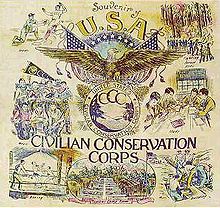
The Civilian Conservation Corps (CCC) was a voluntary authorities work relief program that ran from 1933 to 1942 in the The states for unemployed, single men ages 18–25 and somewhen expanded to ages 17–28.[i] Robert Fechner was the beginning manager of this agency, succeeded by James McEntee following Fechner's death. The CCC was a major part of President Franklin D. Roosevelt'south New Deal that supplied manual labor jobs related to the conservation and development of natural resource in rural lands owned by federal, state, and local governments. The CCC was designed to supply jobs for young men and to salvage families who had difficulty finding jobs during the Smashing Depression in the Us. The largest enrollment at any in one case was 300,000. Through the course of its nine years in operation, three million young men took office in the CCC, which provided them with shelter, wear, and nutrient, together with a wage of $thirty (equivalent to $1000 in 2021) per month ($25 of which had to exist sent home to their families).[2]

CCC-built bridge across Stone Creek in Little Stone, Arkansas
The American public made the CCC the most popular of all the New Deal programs.[3] Sources written at the time claimed[iv] an individual'south enrollment in the CCC led to improved concrete status, heightened morale, and increased employability. The CCC besides led to a greater public awareness and appreciation of the outdoors and the nation's natural resources, and the continued need for a carefully planned, comprehensive national program for the protection and development of natural resources.[v]

CCC workers amalgam a road in what is now Cuyahoga Valley National Park, 1933

154th Co.. CCC, Eagle Lake Camp NP-1-Me. Bar harbor Maine, February 1940

CCC camps in Michigan; the tents were soon replaced by barracks built by Army contractors for the enrollees.[six]
The CCC operated split programs for veterans and Native Americans. Approximately fifteen,000 Native Americans took role in the programme, helping them conditions the Great Depression.[seven]
Past 1942, with World State of war 2 raging and the typhoon in effect, the need for piece of work relief declined, and Congress voted to close the program.[8]
Founding [edit]
As governor of New York, Franklin D. Roosevelt had run a similar program on a much smaller scale, known as the Temporary Emergency Relief Assistants (TERA). It was started in early 1932 to "employ men from the lists of the unemployed to improve our existing reforestation areas." In its commencement year alone, more than 25,000 unemployed New Yorkers would be active in its paid conservation piece of work.[nine] Long interested in conservation,[10] as president, Roosevelt proposed to Congress a full-scale national programme on March 21, 1933:[11]
I propose to create [the CCC] to be used in complex work, not interfering with normal employment and circumscribed itself to forestry, the prevention of soil erosion, alluvion control, and similar projects. I call your attention to the fact that this blazon of work is of definite, practical value, not only through the prevention of neat nowadays financial loss simply also as a means of creating future national wealth.
He promised this law would provide 250,000 young men with meals, housing, workwear, and medical treat working in the national forests and other government properties. The Emergency Conservation Work (ECW) Act was introduced to Congress the aforementioned twenty-four hours and enacted by vocalism vote on March 31. Roosevelt issued Executive Order 6101 on April v, 1933, which established the CCC organization and appointed a director, Robert Fechner, a old labor marriage official who served until 1939. The organization and administration of the CCC was a new experiment in operations for a federal regime agency. The order directed that the program be supervised jointly by four authorities departments: Labor, which recruited the immature men; War, which operated the camps; the Agriculture; and Interior, which organized and supervised the work projects. A CCC Advisory Council was composed of a representative from each of the supervising departments. In add-on, the Office of Education and Veterans Administration participated in the program. To terminate the opposition from labor unions (which wanted no grooming programs started when then many of their men were unemployed)[12] Roosevelt chose Robert Fechner, vice president of the International Association of Machinists and Aerospace Workers, as manager of the corps. William Green, head of the American Federation of Labor, was taken to the first camp to demonstrate that there would be no job training involved beyond elementary manual labor.[13]
U.S. Army [edit]
Reserve officers from the U.S. Army were in accuse of the camps, but there was no armed services preparation. General Douglas MacArthur was placed in charge of the program,[14] only said that the number of army officers and soldiers assigned to the camps was affecting the readiness of the regular ground forces.[15] Withal, the army also found numerous benefits in the program. When the draft began in 1940, the policy was to make CCC alumni corporals and sergeants. The CCC also provided command experience to Organized Reserve Corps officers. George Marshall "embraced" the CCC, unlike many of his blood brother officers.[16]
Through the CCC, the regular army could assess the leadership performance of both regular and reserve officers. The CCC provided lessons which the ground forces used in developing its wartime mobilization plans for grooming camps.[17]
History [edit]
An implicit goal of the CCC was to restore morale in an era of 25% unemployment for all men and much college rates for poorly educated teenagers. Jeffrey Suzik argues in "'Edifice Improve Men': The CCC Boy and the Irresolute Social Ideal of Manliness" that the CCC provided an ideology of manly outdoor work to counter the Depression, too equally cash to assist the family upkeep. Through a authorities of heavy manual labor, borough and political didactics, and an all-male person living and working environment, the CCC tried to build "improve men" who would be economically independent and self-reliant. By 1939, there was a shift in the platonic from the hardy manual worker to the highly trained citizen soldier ready for war.[18]
Early on years, 1933–1937 [edit]

A CCC map of the planned route of a parkway in Texas, drafted in 1934. The Corps worked in numerous parks throughout the country during the early 1930s, constructing everything from benches to highways.
The legislation and mobilization of the plan occurred quite rapidly. Roosevelt made his asking to Congress on March 21, 1933; the legislation was submitted to Congress the same solar day; Congress passed it by voice vote on March 31; Roosevelt signed it the same day, so issued an executive society on April 5 creating the agency, appointing its director (Fechner), and assigning War Department corps surface area commanders to begin enrollment. The first CCC enrollee was selected April 8, and subsequent lists of unemployed men were supplied by state and local welfare and relief agencies for firsthand enrollment. On April 17, the commencement campsite, NF-i, Army camp Roosevelt,[19] was established at George Washington National Forest about Luray, Virginia. On June 18, the start of 161 soil erosion control camps was opened, in Clayton, Alabama.[20] By July 1, 1933, in that location were 1,463 working camps with 250,000 junior enrollees (18–25 years of age); 28,000 veterans; 14,000 American Indians; and 25,000 adults in the Locally Men (LEM) program.[21] [22]
Enrollees [edit]
The typical CCC enrollee was a U.South. citizen, single, unemployed male, 18–25 years of age. Normally his family was on local relief. Each enrollee volunteered and, upon passing a physical exam and/or a menses of workout, was required to serve a minimum half dozen-month period, with the option to serve as many as four periods, or up to ii years, if employment outside the Corps was not possible. Enrollees worked 40 hours per week over 5 days, sometimes including Saturdays if poor weather condition dictated. In render they received $30 per calendar month (equivalent to $600 in 2020) with a compulsory resource allotment of $25 (well-nigh equivalent to $10,800 in 2020) sent to a family unit dependent, as well equally housing, food, clothing, and medical care.[24]
Veterans Conservation Corps [edit]
Post-obit the 2nd Bonus Army march on Washington, D.C., President Roosevelt amended the CCC program on May 11, 1933, to include piece of work opportunities for veterans. Veteran qualifications differed from the junior enrollee; one needed to exist certified past the Veterans Administration by an application. They could be whatever historic period, and married or single as long as they were in need of work. Veterans were by and large assigned to entire veteran camps.[25] Enrollees were eligible for the following "rated" positions to assistance with army camp administration: senior leader, mess steward, storekeeper and 2 cooks; assistant leader, visitor clerk, assistant educational advisor and iii second cooks. These men received additional pay ranging from $36 to $45 per month depending on their rating.
Camps [edit]

Inside of CCC billet at Milford, Utah. Two of the men are sitting on footlockers that were used past the CCC workers to hold their personal possessions.
Each CCC camp was located in the expanse of particular conservation work to exist performed and organized around a complement of up to 200 civilian enrollees in a designated numbered "company" unit. The CCC camp was a temporary customs in itself, structured to take barracks (initially Army tents) for 50 enrollees each, officer/technical staff quarters, medical clinic, mess hall, recreation hall, educational building, lavatory and showers, technical/administrative offices, tool room/blacksmith shop and motor pool garages.

CCC Camp recreational hall or educational edifice (unidentified location)
The company organization of each military camp had a dual-authorisation supervisory staff: firstly, Department of War personnel or Reserve officers (until July ane, 1939), a "company commander" and junior officeholder, who were responsible for overall camp performance, logistics, education and training; and secondly, ten to fourteen technical service civilians, including a campsite "superintendent" and "foreman", employed past either the Departments of Interior or Agriculture, responsible for the particular fieldwork. Too included in camp functioning were several non-technical supervisor LEMs, who provided knowledge of the work at hand, "lay of the land," and paternal guidance for inexperienced enrollees.[26] [27] Enrollees were organized into work particular units called "sections" of 25 men each, according to the barracks they resided in.[28] Each section had an enrollee "senior leader" and "assistant leader" who were answerable for the men at work and in the billet.
Work classifications [edit]

Millhouse and waterwheel at Juniper Springs Florida congenital past the CCC

CCC workers with picks and shovels building a road in Utah betwixt Milford and Beaver
The CCC performed 300 types of piece of work projects in ten approved general classifications:
- Structural improvements: bridges, fire lookout man towers, service buildings
- Transportation: truck trails, small-scale roads, foot trails and airfields
- Erosion control: check dams, terracing, and vegetable covering
- Flood control: irrigation, drainage, dams, ditching, channel work, riprapping
- Wood civilization: tree planting, burn down prevention, burn pre-suppression, firefighting, insect and affliction control
- Mural and recreation: public camp and picnic footing evolution, lake and pond site clearing and development
- Range: stock driveways, emptying of predatory animals
- Wildlife: stream comeback, fish stocking, nutrient and cover planting
- Miscellaneous: emergency work, surveys, mosquito control[29]
The responses to this vii-month experimental conservation program were enthusiastic. On October 1, 1933, Director Fechner was directed to suit for the 2d menstruation of enrollment. By January 1934, 300,000 men were enrolled. In July 1934, this cap was increased past l,000 to include men from Midwest states that had been affected by drought. The temporary tent camps had also developed to include wooden billet. An education programme had been established, emphasizing job training and literacy.[22] : ten
Approximately 55% of enrollees were from rural communities, a majority of which were not-farm; 45% came from urban areas.[30] Level of education for the enrollee averaged 3% illiterate; 38% had less than eight years of schoolhouse; 48% did non consummate loftier school; and 11% were high school graduates.[25] At the time of entry, 70% of enrollees were malnourished and poorly clothed. Few had work experience beyond occasional odd jobs. Peace was maintained by the threat of "dishonorable discharge". "This is a training station; we're going to leave morally and physically fit to lick 'Old Man Depression,'" boasted the newsletter, Happy Days, of a North Carolina camp.
Minorities [edit]
Considering of the power of conservative Solid South white Democrats in Congress, who insisted on racial segregation, nigh New Deal programs were racially segregated; blacks and whites rarely worked alongside each other. At this fourth dimension, all the states of the South had passed legislation imposing racial segregation and, since the turn of the century, laws and constitutional provisions that disenfranchised most blacks; they were excluded from formal politics. Considering of discrimination past white officials at the local and state levels, blacks in the South did not receive as many benefits as whites from New Deal programs.
In the first few weeks of operation, CCC camps in the North were integrated. By July 1935, nonetheless, all camps in the United states of america were segregated.[31] Enrollment peaked at the end of 1935, when there were 500,000 men in two,600 camps in performance in every state. All received equal pay and housing.[32] Black leaders lobbied to secure leadership roles.[33] Adult white men held the major leadership roles in all the camps. Managing director Fechner refused to appoint black adults to any supervisory positions except that of education director in the all-black camps.[34]
Indian Sectionalisation [edit]
The CCC operated a split up division for members of federally recognized tribes: the "Indian Emergency Conservation Work Sectionalisation" (IECW or CCC-ID). Native men from reservations worked on roads, bridges, clinics, shelters, and other public works near their reservations. Although they were organized every bit groups classified as camps, no permanent camps were established for Native Americans. Instead, organized groups moved with their families from projection to projection and were provided with an boosted rental allowance.[35] The CCC ofttimes provided the only paid piece of work, as many reservations were in remote rural areas. Enrollees had to be betwixt the ages of 17 and 35.
During 1933, about half the male heads of households on the Sioux reservations in South Dakota were employed by the CCC-ID.[36] With grants from the Public Works Assistants (PWA), the Indian Division built schools and conducted a road-building program in and around many reservations to ameliorate infrastructure. The mission was to reduce erosion and ameliorate the value of Indian lands. Crews built dams of many types on creeks, then sowed grass on the eroded areas from which the damming material had been taken. They built roads and planted shelter-belts on federal lands. The steady income helped participants regain self-respect, and many used the funds to improve their lives. John Collier, the federal Commissioner of Indian Affairs and Daniel White potato, the director of the CCC-ID, both based the program on Indian self-rule and the restoration of tribal lands, governments, and cultures. The next yr, Congress passed the Indian Reorganization Act of 1934, which ended allotments and helped preserve tribal lands, and encouraged tribes to re-establish self-government.
Collier said of the CCC-Indian Division, "no previous undertaking in Indian Service has so largely been the Indians' own undertaking". Educational programs trained participants in gardening, stock raising, prophylactic, native arts, and some academic subjects.[37] IECW differed from other CCC activities in that it explicitly trained men in skills to exist carpenters, truck drivers, radio operators, mechanics, surveyors, and technicians. With the passage of the National Defense Vocational Training Act of 1941, enrollees began participating in defense-oriented preparation. The regime paid for the classes and after students completed courses and passed a competency test, guaranteed automatic employment in defense work. A full of 85,000 Native Americans were enrolled in this grooming. This proved valuable social upper-case letter for the 24,000 alumni who later served in the military and the 40,000 who left the reservations for city jobs supporting the war endeavour.
Expansion, 1935–1936 [edit]
Responding to public demand to alleviate unemployment, Congress approved the Emergency Relief Appropriation Act of 1935, on Apr viii, 1935, which included continued funding for the CCC programme through March 31, 1937. The age limit was expanded to eighteen–28 to include more men.[22] : 11 [38] April i, 1935, to March 31, 1936, was the period of greatest activity and work accomplished by the CCC plan. Enrollment peaked at 505,782 in about 2,900 camps past Baronial 31, 1935, followed by a reduction to 350,000 enrollees in 2,019 camps by June xxx, 1936.[39] During this period the public response to the CCC programme was overwhelmingly popular. A Gallup poll of April xviii, 1936, asked: "Are you in favor of the CCC camps?"; 82% of respondents said "yes", including 92% of Democrats and 67% of Republicans.[xl]
Alter of purpose, 1937–1938 [edit]
On June 28, 1937, the Civilian Conservation Corps was legally established and transferred from its original designation as the Emergency Conservation Work plan. Funding was extended for three more years by Public Law No. 163, 75th Congress, effective July ane, 1937. Congress changed the age limits to 17–23 years erstwhile and changed the requirement that enrollees exist on relief to "non regularly in omnipresence at school, or possessing full-time employment."[41] The 1937 law mandated the inclusion of vocational and bookish training for a minimum of 10 hours per week. Students in school were immune to enroll during summer vacation.[42] During this period, the CCC forces contributed to disaster relief following 1937 floods in New York, Vermont, and the Ohio and Mississippi river valleys, and response and clean-up afterwards the 1938 hurricane in New England.
From conservation to defense, 1939–1940 [edit]
In 1939 Congress ended the contained condition of the CCC, transferring it to the command of the Federal Security Agency. The National Youth Assistants, U.South. Employment Service, the Part of Education, and the Works Progress Administration also had some responsibilities. About 5,000 reserve officers serving in the camps were afflicted, as they were transferred to federal Ceremonious Service, and military machine ranks and titles were eliminated. Despite the loss of overt armed forces leadership in the camps by July 1940, with state of war underway in Europe and Asia, the government directed an increasing number of CCC projects to resources for national defense. Information technology adult infrastructure for military machine preparation facilities and wood protection. By 1940 the CCC was no longer wholly a relief agency, was rapidly losing its non-military character, and information technology was becoming a organisation for piece of work-training, as its ranks had go increasingly younger and inexperienced.[43]
Decline and disbandment 1941–1942 [edit]
Although the CCC was probably the most popular New Deal program, it never was authorized as a permanent agency. The program was reduced in scale as the Depression waned and employment opportunities improved. Later conscription began in 1940, fewer eligible young men were available. Post-obit the attack on Pearl Harbor in December 1941, the Roosevelt administration directed all federal programs to emphasize the war attempt. Most CCC piece of work, except for wildland firefighting, was shifted onto U.S. military bases to aid with construction.
The CCC disbanded one yr earlier than planned, every bit the 77th United States Congress ceased funding it. Operations were formally concluded at the end of the federal fiscal year on June 30, 1942. The end of the CCC program and endmost of the camps involved arrangements to leave the incomplete piece of work projects in the best possible state, the separation of about 1,800 appointed employees, the transfer of CCC property to the War and Navy Departments and other agencies, and the preparation of final accountability records. Liquidation of the CCC was ordered past Congress past the Labor-Federal Security Cribbing Act (56 Stat. 569) on July ii, 1942, and virtually completed on June 30, 1943.[44] Liquidation appropriations for the CCC connected through April xx, 1948.
Some one-time CCC sites in good condition were reactivated from 1941 to 1947 as Civilian Public Service camps where conscientious objectors performed "piece of work of national importance" as an culling to armed forces service. Other camps were used to concord Japanese, High german and Italian Americans interned under the Western Defence Command's Enemy Conflicting Control Plan, besides as Centrality prisoners of war.[45] Most of the Japanese American internment camps were built past the people held there. Later the CCC disbanded, the federal agencies responsible for public lands organized their own seasonal fire crews, modeled after the CCC. These have performed a firefighting function formerly done past the CCC and provided the same sort of outdoor piece of work feel for young people. Approximately 47 immature men take died while in this line of duty.[ citation needed ]
A CCC pillowcase on display at the CCC Museum in Michigan
Museums [edit]
- Civilian Conservation Corps Museum at DeSoto State Park, Fort Payne, Alabama
- Civilian Conservation Corps Museum and Memorial,[46] at Monte Sano State Park, Huntsville, Alabama
- Jumbo Cave Mountain Park, Vail, Arizona
- Conservation Corps Country Museum at Army camp San Luis Obispo, San Luis Obispo, California
- North East States Civilian Conservation Corps Museum,[47] Camp Conner, Stafford, Connecticut
- Florida Civilian Conservation Corps Museum at Highlands Hammock Land Park, Sebring, Florida
- Civilian Conservation Corps Museum, Vogel Country Park, Blairsville, Georgia
- Civilian Conservation Corps Camp in Kokeʻe State Park, Waimea, Kauai Canton, Hawaii
- Starved Stone Land Park (CCC Section in the visitors' center) Oglesby, Illinois
- Iowa Civilian Conservation Corps Museum at Courage State Park, Strawberry Point, Iowa
- Michigan Civilian Conservation Corps Museum,[48] Roscommon, Michigan
- Comport Brook Country Park Civilian Conservation Corps (CCC) Camp Celebrated District, Allenstown, New Hampshire
- New York State Civilian Conservation Corps Museum at Gilbert Lake State Park, New Lisbon, New York
- Masker Museum at Promised State Country Park, Greentown, Pennsylvania
- Lou and Helen Adams Civilian Conservation Corps Museum, Parker Dam Country Park, Huston Township, Clearfield County, Pennsylvania
- Civilian Conservation Corps Museum at Lake Greenwood State Recreation Area, 90 Half-dozen, S Carolina
- Civilian Conservation Corps Museum at Pocahontas State Park, Chesterfield, Virginia
- Civilian Conservation Corps Legacy,[49] Edinburg, Virginia
- Noncombatant Conservation Corps Museum, Rhinelander, Wisconsin
- West Virginia CCC Museum,[fifty] Harrison County, Westward Virginia
- Civilian Conservation Corps Museum, Guernsey State Park, Guernsey, Wyoming
- James F. Justin Civilian Conservation Corps Museum[51]
Notable alumni and administrators [edit]
- David "Stringbean" Akeman, enrollee, land music singer
- Raymond Burr, enrollee, player
- Borden Bargain, enrollee
- Hutton Gibson, writer
- Archie Light-green, enrollee, folklorist
- Henry Gurke, enrollee
- Ralph Hauenstein. Regular army officer in accuse of campsite
- Hubert D. Humphreys, historian
- Aldo Leopold, former technical forester, ecologist, environmentalist
- Stanley Makowski, enrollee
- Walter Matthau, enrollee, actor
- Robert Mitchum, enrollee, role player
- Archie Moore, enrollee, the Low-cal Heavyweight Battle Champion of the World
- Stan Musial, enrollee, professional baseball player
- Edward R. Roybal, enrollee, politician
- Crimson Schoendienst, enrollee, baseball game player/manager
- Dan White, enrollee, American actor in vaudeville, theater, radio, film and television
- Conrad L. Wirth, U.S. administrator, National Park Service supervisor of CCC Program
- Chuck Yeager, enrollee, test pilot
- Alvin C. York, a project superintendent
Statues [edit]

In several cities where CCC workers worked, statues were erected to commemorate them.[52]

In media [edit]
- Pride of the Bowery (1940), the fourth motion-picture show in the Eastward Side Kid series, is a flick about friendship, trouble, and battle at a CCC army camp.
- The American Experience [53] PBS series showcased documentaries on American history; it portrayed the life in Civilian Conservation Corps in 2009, in the get-go episode of Flavour 22.[54]
- Jeanette Ingold'south novel Hitch (2012) is a young adult book about a teenager in the CCC.[55]
Inspired programs [edit]
The CCC programme was never officially terminated. Congress provided funding for endmost the remaining camps in 1942 with the equipment beingness reallocated.[56] It became a model for conservation programs that were implemented in the period afterward World State of war II. Present-day corps are national, country, and local programs that engage primarily youth and young adults (ages 16–25) in community service, training, and educational activities. The nation's approximately 113 corps programs operate in 41 states and the District of Columbia. During 2004, they enrolled more than 23,000 young people. The Corps Network, known originally every bit the National Clan of Service and Conservation Corps (NASCC), works to expand and enhance corps-type programs throughout the country. The Corps Network began in 1985 when the nation's first 24 Corps directors banded together to secure an abet at the federal level and a repository of information on how best to outset and manage a corps. Early financial help from the Ford, Hewlett and Mott Foundations was critical to establishing the association.
Similar active programs in the Us are: the National Civilian Customs Corps, office of the AmeriCorps programme, a team-based national service program in which young adults ages eighteen–24 spend x months working for non-turn a profit and government organizations; and the Civilian Conservation Corps, Us, (CCCUSA) managed past its president, Thomas Hark, in 2016. Hark, his co-founder Mike Rama, currently the Deputy Manager of the Corporate Eco Forum (CEF) founded by M. R. Rangaswami, and their team of strategic advisors have reimagined the federal Civilian Conservation Corps program of the 1930s as a individual, locally governed, national social franchise. The goal of this recently established CCCUSA is to enroll a million young people annually, building a core set of values in each enrollee, who will then get the catalyst in their own communities and states to create a more civil society and stronger nation.[57]
Student Conservation Clan [edit]
The CCC program became a model for the creation of team-based national service youth conservation programs such equally the Student Conservation Association (SCA). The SCA, founded in 1959, is a nonprofit arrangement that offers conservation internships and summer trail crew opportunities to more than than iv,000 people each year.
California Conservation Corps [edit]
In 1976, Governor of California Jerry Dark-brown established the California Conservation Corps. This program had many similar characteristics - residential centers, loftier expectations for participation, and accent on hard piece of work on public lands. Young adults from dissimilar backgrounds were recruited for a term of one yr. Corps members attended a training session chosen the Corpsmember Orientation Motivation Instruction and Training (COMET) program before being assigned to i of the various centers. Project work is besides like to the original CCC of the 1930s - work on public forests, state and federal parks.
Nevada Conservation Corps [edit]
The Nevada Conservation Corps is a non-turn a profit organization that partners with public country management agencies such as the Bureau of Land Management, United states of america Woods Service, National Park Service, and Nevada State Parks to consummate conservation and restoration projects throughout Nevada.[58] Conservation work includes fuel reductions through thinning, amalgam and maintaining trails, invasive species removal, and performing biological surveys.[59] The Nevada Conservation Corps was created through the Cracking Basin Plant and is part of the AmeriCorps plan.[60]
Minnesota Conservation Corps [edit]
Conservation Corps Minnesota & Iowa provides environmental stewardship and service-learning opportunities to youth and immature adults while accomplishing conservation, natural resources management projects and emergency response piece of work through its Immature Developed Program and the Summer Youth Plan. These programs emphasize the evolution of job and life skills by conservation and community service piece of work.
Montana Conservation Corps [edit]
The Montana Conservation Corps (MCC) is a non-turn a profit arrangement with a mission to equip young people with the skills and values to be vigorous citizens who ameliorate their communities and environment. Collectively, MCC crews contribute more than xc,000 work hours each year. The MCC was established in 1991 by Montana'southward Human Resource Development Councils in Billings, Bozeman and Kalispell. Originally, it was a summertime program for disadvantaged youth, although it has grown into an AmeriCorps-sponsored non-turn a profit organization with six regional offices that serve Montana, Idaho, Wyoming, Northward Dakota, and Southward Dakota. All regions also offering Montana YES (Youth Engaged in Service) summer programs for teenagers who are xiv to 17 years onetime.
Texas Conservation Corps [edit]
Established in 1995, Environmental Corps, now Texas Conservation Corps (TxCC), is an American YouthWorks program which allows youth, ages 17 to 28, to contribute to the restoration and preservation of parks and public lands in Texas. The only conservation corps in Texas, TxcC is a nonprofit corporation based in Austin, Texas, which serves the entire state. Their work ranges from disaster relief to trail edifice to habitat restoration. TxCC has done projects in national, state, and metropolis parks.
Washington Conservation Corps [edit]
The Washington Conservation Corps (WCC) is a sub-agency of the Washington State Department of Ecology. Information technology employs men and women 18 to 25 years old in a program to protect and enhance Washington'due south natural resources. WCC is a part of the AmeriCorps program.
Vermont Youth Conservation Corps [edit]
The Vermont Youth Conservation Corps (VYCC) is a non-profit, youth service and pedagogy organization that hires Corps Members, aged 16–24, to work on loftier-priority conservation projects in Vermont. Through these work projects, Corps Members develop a strong work ethic, strengthen their leadership skills, and acquire how to have personal responsibility for their actions. VYCC Crews piece of work at VT State Parks, U.S. Forest Service Campgrounds, in local communities, and throughout the state'southward backcountry. The VYCC has too given assistance to a similar program in North Carolina, which is currently in its infancy.
Youth Conservation Corps [edit]
The Youth Conservation Corps is a youth conservation program present in federal lands around the country. The program gives youth aged 13–17 the opportunity to participate in conservation projects in a team setting. YCC programs are available in country managed by the National Park Service, the Woods Service, and the Fish and Wildlife Service. Projects tin last up to 10 weeks and typically run over the summertime. Some YCC programs are residential, pregnant the participants are given housing on the land they work on. Projects may necessitate youth to campsite in backcountry settings in club to work on trails or campsites. Most require youth to commute daily or house youth for simply a few days a week. Youth are typically paid for their work. YCC programs contribute to the maintenance of public lands and instill a value for hard work and the outdoors in those who participate.
Conservation Legacy [edit]
Conservation Legacy is a non-profit employment, task training, and education organization with locations beyond the United States including Arizona Conservation Corps in Tucson and Flagstaff, Arizona; Southwest Conservation Corps in Durango and Salida, Colorado; and Southeast Conservation Corps in Chattanooga, Tennessee. Conservation Legacy also operates an AmeriCorps VISTA team serving to amend the surround and economies of historic mining communities in the American West and Appalachia. Conservation Legacy also hosts the Environmental Stewards Program - providing internships with federal, land, municipal and NGO land management agencies nationwide.[61] Conservation Legacy formed every bit a merger of the Southwest Youth Corps, San Luis Valley Youth Corps, The Youth Corps of Southern Arizona, and Coconino Rural Environmental Corps.
Conservation Legacy engages immature adults ages 14 to 26 and U.S. military machine veterans of all ages in personal and professional development experiences involving conservation projects on public lands. Corp members live, work, and larn in teams of half-dozen to eight for terms of service ranging from 3 months to 1 year.
Sea Ranger Service [edit]
The Sea Ranger Service is a social enterprise, based in Netherlands, that has taken its inspiration from the Civilian Conservation Corps in running a permanent youth preparation program, supported by veterans, to manage ocean areas and deport out underwater landscape restoration. Unemployed youths are trained up equally Sea Rangers during a bootcamp and subsequently offered full-fourth dimension employment to manage and regenerate Marine Protected Areas and assist ocean conservation. The Body of water Ranger Service works in shut cooperation with the Dutch government and national maritime authorities.[62]
Aina Corps [edit]
The Aina Corps performed ecology restoration work in Hawaii in 2020, funded by the CARES Act.[63]
Meet too [edit]
- Camp Petenwell
- Military camp San Luis Obispo
- Rabideau CCC Campsite
- She-She-She Camps
- Table Stone Civilian Conservation Corps Camp Site
References [edit]
- ^ "Timeline. The Civilian Conservation Corps". American Experience. WGBH - PBS. Archived from the original on Dec 25, 2016.
{{cite spider web}}: CS1 maint: unfit URL (link) - ^ John A. Salmond, The Civilian Conservation Corps CCC 1933–1942: a New Bargain example study (1967)
- ^ Perry H. Merrill, Roosevelt's Woods Ground forces, A History of the Civilian Conservation Corps (1981) p. 196
- ^ "CONSERVATION: Poor Young Men". Time. Feb 6, 1939 – via content.time.com.
- ^ Robert Allen Ermentrout, "Forgotten Men: The Civilian Conservation Corps," (1982) p. 99
- ^ Rosentreter, Roger L. "Roosevelt's Tree Army". Michigan History Mag.
- ^ Landry, Alysa (August nine, 2016). "Franklin Delano Roosevelt: A New Deal for Indians". Indian Country Today. Archived from the original on August 12, 2016. Retrieved Baronial 9, 2016.
- ^ Wirth, pp. 105, 142-144
- ^ John Gibbs, "Tree Planting Aids Unemployed", American Forests (April 1933) pp. 159–61.
- ^ Salmond, John A. (Jan three, 2008). "The Civilian Conservation Corps 1933–1942: a New Bargain case report". nps.gov. Archived from the original on June 29, 2011. Retrieved April 26, 2010.
- ^ "Bulletin to Congress on Unemployment Relief. March 21," The Presidential Papers of Franklin D. Roosevelt, 1933 (1938)
- ^ Neil M. Meher, Nature's New Bargain: The Civilian Conservation Corps and the Roots of the American Ecology Movement (2009), p. 79
- ^ On the CCC's formation run across Frank Freidel, Franklin D. Roosevelt: Launching the New Deal (1973), pp. 255-266
- ^ Darby, Jean Douglas. MacArthur, Twenty-First Century Books, 1989, p. 47
- ^ Imparato, Edward T., editor. "Outcome of the Civilian Conservation Corps Projection upon Army Action and Readiness for Emergency". General MacArthur Speeches and Reports 1908–1964. Turner Publishing Visitor, 2000, p. 58.
- ^ Roberts 2009, p. 25. sfn error: no target: CITEREFRoberts2009 (help)
- ^ Charles Due east. Heller, "The U.Southward. Army, the Civilian Conservation Corps, and Leadership for World State of war II, 1933–1942", Armed Forces & Guild (2010) 36#three pp. 439–453 online
- ^ Jeffrey Ryan Suzik, "'Building Better Men': The CCC Boy and the Irresolute Social Ideal of Manliness", Men and Masculinities 2.2 (1999): 152-179.
- ^ "Army camp Roosevelt, NF-i". Archived from the original on December 1, 2008.
- ^ "Timeline. Surviving the Dust Bowl. American Experience . WGBH - PBS". PBS . Retrieved March 2, 2012.
- ^ Ermentrout, p. 15
- ^ a b c Fechner, Robert, Director (1938). Pamphlet: Objectives and Results of the Noncombatant Conservation Corps Program. Washington, D.C: Civilian Conservation Corps.
- ^ Parks, Politics, and the People, Affiliate v: The Civilian Conservation Corps, National Park Service official website.
- ^ Wirth, Conrad Fifty. (1980). Parks, Politics and the People. Norman: University of Oklahoma Printing. pp. 94–99. ISBN0-8061-1605-half-dozen.
- ^ a b Ermentrout, Robert Allen (1982). Forgotten Men: The Civilian Conservation Corps. Smithtown, NY: Exposition Press. p. 17. ISBN0-682-49805-X.
- ^ "Your CCC, A Handbook for Enrollees," Happy Days Pub. Co., Inc. (1940) pp. viii–13
- ^ Ermentrout, pp. 16, 76-77
- ^ "United States Army Noncombatant Conservation Corps. Visitor 114th," Francis P. Waversak, Stone Walls, Jump 1990 p. 23
- ^ Merrill, Perry H. (1981) Roosevelt's Forest Regular army, A History of the Noncombatant Conservation Corps, p. 9
- ^ "Your CCC, A Handbook for Enrollees", Happy Days Pub. Co., Inc. (1940) p. 9
- ^ Kay Rippelmeyer (2015). The Noncombatant Conservation Corps in Southern Illinois, 1933-1942. Southern Illinois Press. pp. 98–99. ISBN9780809333653.
- ^ "Civilian Conservation Corps (CCC)". www.u-south-history.com . Retrieved Feb 22, 2019.
- ^ Salmond, John A. (June 1965). "The Civilian Conservation Corps and the Negro". The Journal of American History. Oxford University Press. 52, 1 (1): 82. doi:10.2307/1901125. JSTOR 1901125.
- ^ Gower, Calvin W. (1976). "The Struggle of Blacks for Leadership Positions in the Civilian Conservation Corps: 1933–1942". Journal of Negro History. 61 (2): 123–135. doi:10.2307/2717266. JSTOR 2717266. S2CID 149689541.
- ^ Gower, Calvin W. (1972). "The CCC Indian Partition: Aid for Depressed Americans, 1933–1942". Minnesota History. 43 (i): three–13.
- ^ Bromert, Roger (1978). "The Sioux and the Indian-CCC". South Dakota History. 8 (4): 340–356.
- ^ Hanneman, Carolyn Thou. (1999). "Baffles, Bridges, and Bermuda: Oklahoma Indians and the Civilian Conservation Corps-Indian Sectionalization". Chronicles of Oklahoma. 77 (iv): 428–449.
- ^ "Digital Athenaeum". Archived from the original on July 28, 2020. Retrieved January xx, 2021.
- ^ Ermentrout, p. 33
- ^ Public Opinion, 1935–1946, ed. by Hadley Cantril and Mildred Strunk (1951), p. 111
- ^ Civilian Conservation Corps, "Standards of Eligibility and Selection for Junior Enrollees," Usa Dept. of Labor, Office of the Secretarial assistant, August 1, 1938,
- ^ Ermentrout, pp. 48–49, 51
- ^ Ermentrout, pp. 55, 62, 64
- ^ Wirth, Conrad 50., Civilian Conservation Corps Program of the U.s. Dept. of the Interior, March 1933 to June xxx, 1942, a Report to Harold L. Ickes, January 1944
- ^ "Civilian Conservation Corps". Densho Encyclopedia. Retrieved August xix, 2016.
- ^ "Archived copy". www.alapark.com. Archived from the original on January xvi, 2015. Retrieved January 15, 2022.
{{cite web}}: CS1 maint: archived re-create as title (link) - ^ "Yahoo | Mail, Weather, Search, Politics, News, Finance, Sports & Videos". Archived from the original on August 8, 2009.
- ^ "DNR MHC Civilian Conservation Corps Museum".
- ^ "CCC Legacy Home".
- ^ "The Museum".
- ^ "James F. Justin Civilian Conservation Corps Museum".
- ^ "CCC Statues". National New Deal Preservation Clan. Archived from the original on June 14, 2008. Retrieved August xix, 2016.
- ^ jtf87 (Oct 4, 1988). "American Feel (Tv set Series 1988– )". IMDb.
- ^ dimplet (November two, 2009). ""American Experience" Civilian Conservation Corps (Idiot box Episode 2009)". IMDb.
- ^ "Another Author: Book Review: HITCH - Making Good in Hard Times". Becomingprince.blogspot.com. February 19, 2012. Retrieved August 19, 2016. .
- ^ "Timeline. The Civilian Conservation Corps. American Experience. WGBH - PBS". American Feel.
- ^ "Leadership Team". Noncombatant Conservation Corps, USA.
- ^ "Frequently Asked Questions". The Bang-up Basin Plant . Retrieved January 1, 2021.
- ^ "Nevada Conservation Corps". The Great Basin Institute . Retrieved Jan 1, 2021.
- ^ "About". The Great Bowl Plant . Retrieved January 1, 2021.
- ^ "Home - Conservation Legacy". July 2019.
- ^ "Unemployed Dutch youth become body of water rangers to protect marine life". Apolitical . Retrieved February 23, 2019.
- ^ Ryan Finnerty. "Hawaii Reboots Depression-Era Conservation Corps Using Pandemic Assistance Funds". NPR.org.
Farther reading [edit]
- Alexander, Benjamin F. The New Deal's Forest Army: How the Noncombatant Conservation Corps Worked. (2018) "+New+Bargain'south+Forest+Regular army" online review
- American Youth Commission. Youth and the Future: The Full general Report of the American Youth Committee (1942)
- Bass, Melissa. The Politics and Civics of National Service: Lessons from the Noncombatant Conservation Corps, Vista, and AmeriCorps (Brookings Institution Printing, 2013)
- Brandimarte, Cynthia, and Angela Reed Brown. Texas State Parks and the CCC: The Legacy of the Civilian Conservation Corps (2013)
- Clancy, Patrick. "Conserving the Youth: the Noncombatant Conservation Corps Feel in the Shenandoah National Park" The Virginia Magazine of History and Biography Volume: 105. Result: 4. 1997. p. 439ff. online
- Colen, Olen Jr. The African-American Experience in the Civilian Conservation Corps (1999)
- Heller, Charles E. "The U.s.a. Regular army, the Noncombatant Conservation Corps, and Leadership for World War II, 1933—1942." Armed Forces & Society (2010) 36#three pp: 439–453.
- Helms, Douglas. "The Civilian Conservation Corps: Demonstrating the Value of Soil Conservation," Journal of Soil and Water Conservation xl (March–April 1985): 184-188 online
- Hendrickson Jr.; Kenneth E. "Replenishing the Soil and the Soul of Texas: The Civilian Conservation Corps in the Lone Star Land as an Example of State-Federal Work Relief during the Dandy Low" The Historian, Vol. 65, 2003
- Hill, Edwin G. In the Shadow of the Mount: The Spirit of the CCC. (1990). ISBN 978-0-87422-073-5
- Holland, Kenneth, and Frank Ernest Hill. Youth in the CCC (1938) detailed description of all major activities
- Jolley, Harley E. "That Magnificent Army of Youth and Peace": The Civilian Conservation Corps in North Carolina, 1933-1942 (Raleigh: Part of Archives and History, 2007) 167pp.
- Leighninger, Robert D., Jr. Long-Range Public Investment: The Forgotten Legacy of the New Deal (2007), providing a context for American public works programs, and detailing major agencies of the New Deal: CCC, PWA, CWA, WPA, and TVA.
- Maher, Neil M. Nature'south New Bargain: The Civilian Conservation Corps and the Roots of the American Environmental Motion (2008). excerpt and text search; also online review
- Mielnik, Tara Mitchell. New Deal, New Landscape: The Civilian Conservation Corps and South Carolina's Country Parks (Academy of South Carolina Press; 2011) 201 pages; CCC congenital 16 land parks in SC between 1933 and 1942.
- Otis, Alison T., William D. Honey, Thomas C. Hogg, and Kimberly K. Lakin The Forest Service and The Noncombatant Conservation Corps: 1933–42 (United states Wood Service FS-395, August 1986) online
- Paige, John C. The Civilian Conservation Corps and the National Park Service, 1933–1942: An Administrative History. (National Park Service, 1985) online
- Pasquill, Jr., Robert. The Civilian Conservation Corps in Alabama, 1933-1942: A Great and Lasting Good (University of Alabama Printing, 2008) 242 pp, with cd of oral interviews
- Patel, Kiran Klaus. Soldiers of Labor. Labor Service in Nazi Germany and New Deal America, 1933–1945, (2005), ISBN 0-521-83416-3. online review
- Roberts, Andrew (2008). Masters and Commanders. How Roosevelt, Churchill, Marshall and Alanbrooke won the war in the west. Allen Lane. ISBN978-0-7139-9969-3. (pb 2009) Online free to borrow
- Salmond John A. The Civilian Conservation Corps 1933–1942: a New Bargain case study. (1967), the scholarly history of the entire CCC complete text online
- Salmond, John A. "The Noncombatant Conservation Corps and the Negro," The Periodical of American History, Vol. 52, No. 1. (Jun. 1965), pp. 75–88. in JSTOR
- Sherraden, Michael W. "Military Participation in a Youth Employment Plan: The Civilian Conservation Corps," War machine and Society, vol. vii, no. 2, pp. 227–245, Apr 1981, pp. 227–245; ISSN 0095-327X bachelor online from SAGE Publications
- Sommer, Barbara West. Hard Work and a Good Deal: The Civilian Conservation Corps in Minnesota (2008).
- Sommer, Barbara W. "' We Had This Opportunity': African Americans and the Civilian Conservation Corps in Minnesota" in The State We're In: Reflections on Minnesota History, Annette Atkins and Deborah Fifty. Millers, eds. (2010) pp 134–157.
- Steely, James W. "Parks for Texas: Enduring Landscapes of the New Deal" (1999), detailing the interaction of local, state and federal agencies in organizing and guiding CCC work.
- Waller, Robert A. "The Civilian Conservation Corps and the Emergence of Southward Carolina's State Park System, 1933–1942*South Carolina Historical Magazine Volume: 104#two 2003, p. 101ff.
- Wilson, James; "Community, Civility, and Citizenship: Theatre and Indoctrination in the Civilian Conservation Corps of the 1930s" Theatre History Studies, Vol. 23, 2003, pp. 77–92
Indian Division [edit]
- Gower, Calvin W. "The CCC Indian Division: Aid for Depressed Americans, 1933–1942," Minnesota History 43 (Spring 1972) 7-12
- Parman, Donald L. The Navajos and the New Deal (1969)
- Parman, Donald L. "The Indian and the CCC," Pacific Historical Review 40#one (Feb 1971): 39-56 online
Master sources [edit]
- CCC, "The Civilian Conservation Corps, What It Is and What Information technology Does" Archived April 21, 2020, at the Wayback Machine (June 1940)
External links [edit]
-
 Media related to Civilian Conservation Corps at Wikimedia Commons
 - Civilian Conservation Corps (CCC) Legacy A merged non-profit foundation of the former National Clan of CCC Alumni (NACCCA) and the Army camp Roosevelt CCC Legacy Foundation
- National Archives & Records Administration: Records of the Noncombatant Conservation Corps (CCC)
- The Corps Network (formerly known every bit NASCC)
- Wecantakeit.org, grassroots non-profit to reestablish the USCCC, based in St Petersburg, Florida
- Bandelier National Monument Virtual Museum Showroom and Lesson Plans, from National Park Service
- Life in the Civilian Conservation Corps Primary Source Adventure, a lesson plan hosted by CCC in Texas
- Top 10 New Deal Programs
- James F Justin Civilian Conservation Corps Museum, Online CCC Biographies Stories Photographs, and Documents
- LeRoy, Congerville sites of CCC camps - Pantagraph (Bloomington, Illinois newspaper)
- Civilian Conservation Corps (CCC): The Arcadia Veteran bulletins from the Rhode Island Country Archives
- https://web.archive.org/web/20070807170035/http://www.qmmuseum.lee.army.mil/ccc_forest.htm Army Quartermaster support to the Civilian Conservation Corps during the Great Depression
Civilian Conservation Corps by country [edit]
- CCC in Idaho Video produced past Idaho Public Idiot box
- CCC History Archives in Massachusetts
- Rosentreter, Roger L. "Roosevelt's Tree Ground forces: Michigan's Civilian Conservation Corps", with photographs
- Encyclopedia of Oklahoma History and Civilization, "Civilian Conservation Corps"
- A New Deal for Texas Parks - interactive web album of CCC activities in Texas
- CCC camps map, a guide to projects in Washington State, with rare photographs. Great Low in Washington State Projection
- Webster M. Pidgeon Papers: Civilian Conservation Corps (CCC) photographs and memorabilia from the Rhode Isle State Athenaeum
- Built To Last: The Legacy of the Civilian Conservation Corps in Minnesota
Individual camps [edit]
- PelMar Publishing Henderson, James D. Lost in the Forest–The Legacy of CCC Military camp Pelican], (2009).
- Siuslaw National Woods; History Department; Portland Country University. "Army camp 56: An Oral History Project: World State of war II Conscientious Objectors and the Waldport, Oregon Civilian Public Service Camp" (PDF). Center for Columbia River History. Archived from the original (PDF) on June 4, 2013. Retrieved Baronial 15, 2013.
Images [edit]
- Images of the Civilian Conservation Corps on the Oregon Land University Athenaeum Flickr Commons page.
- CNY Heritage Digital Library, featuring images of Civilian Conservation Corps members constructing Green Lakes State Park in Fundamental New York (1929–1948).
Documentary, feature and Boob tube movies [edit]
- "The Great Low, Displaced Mountaineers in Shenandoah National Park, and the Civilian Conservation Corps (C.C.C.)", on YouTube
- Youth Jobs Plan (CCC) During Great Depression, The March of Fourth dimension
- President Visits Foresters (CCC), Roosevelt 1933/08/fourteen, newsreel
- Recreation Resource, 1935, Due west Virginia, bachelor through NARA (National Archives and Records Assistants)
- A Nationwide System of Parks 1939, NARA
- Alabama Highlands 1937 Alabama State Parks, NARA
- Down Mobile Manner, 1935 Alabama State Parks, NARA
- The Cradle of the Male parent of Waters, 1938 Minnesota Country Parks, Lake Itasca State Park, NARA
- Great Smoky Mountains National Park, 1936, NARA
- Land of the Giants, 1935 California, NARA
- The East Side Kids (Pride of the Bowery, 1941), Leo Gorcey - Bobby Jordan
- American Feel: The Civilian Conservation Corps, PBS American Experience, 2009
- Parks Nether the Lone Star, 1933 motion picture detailing Texas CCC projects, Texas Annal of the Moving Epitome
Source: https://en.wikipedia.org/wiki/Civilian_Conservation_Corps
0 Response to "Us History Cca#3 (Constitution) Review - Fall 2017"
Post a Comment