Why Do We Need to Understand Ancient Chinese Art
Collecting Guide: 7 things to know about Chinese traditional painting
Specialist Elizabeth Hammer looks at why age-old themes and techniques continue to flourish, illustrated with lots from upcoming and previous sales
There is room for confusion over the category known as Chinese traditional painting. The works in this field range from classical paintings that predate the 20th century through to contemporary paintings, all of which apply in some mode age-old themes, materials and techniques.
Artists apply ink and h2o-based colour on paper or silk to create traditional tableaus, most often depicting landscapes. Additionally, the themes are rarely unique, but are variations of earlier compositions, continuing a solid historical thread. The differences are in the details.
'At that place is a very stiff relationship between what comes later and what goes before in Chinese traditional painting,' says Elizabeth Hammer, head of sale of Chinese Classical and Modern Paintings at Christie'south New York.
'There's an idea that if you launch out without knowing thoroughly what came before you lot, you have no foundation,' explains Hammer. 'Traditional painting has a much stronger connexion with the past than it does to global fine art trends.'
- 1
.jpg?w=780)
Lu Yanshao (1909-1993), Poetic Images of the Tang Dynasty. Each foliage measures 8¼ ten 11 in (21 ten 28 cm). Sold for $75,000 on 19 March 2019 at Christie's in New York
Given that Chinese traditional painters learned their craft by copying earlier masters, information technology can be very hard to distinguish an original from a re-create, especially if the work is very old. Even if the creative person was not deliberately creating a fake, the copy might have been confused with an original at some indicate.
Equally a result, even experts accept a hard time guaranteeing authenticity. If you get five experts in a room, Hammer says jokingly, they'll end up with seven different opinions near a painting. 'At that place are no short cuts to authenticating,' she says. 'It requires a bully deal of time and study, and information technology is nevertheless largely subjective.'
Although classical paintings are highly treasured, the easiest approach, Hammer says, is to larn a traditional Chinese painting that has a straight connection to the artist who made it. That said, paintings fabricated during the Vocal, Yuan and Ming dynasties continue to be coveted by collectors.
During the past few years, the nigh desirable works have been those owned past or fabricated for the 18th-century imperial court of the emperor Qianlong, who assembled one of the world's largest art collections. In these works, identified by Emperor Qianlong's collector'south seals, everything — the painting quality, the materials, the presentation — is the absolute best. Or in other words, fit for an emperor.
- 2
Chinese paintings come up in a variety of styles. Some are monochrome, and others are very brightly coloured. Some are made in the literati way, pregnant that they tend to utilize expressionistic brushwork and were painted as an expression of personal creativity. Others are fabricated in gong-bi, or 'meticulous', style, utilising very precise details to appear much more decorative.
.jpg?w=780)
Yun Shouping (1633-1690), Flowers and Fruits Album. Each foliage measures 25.iii x 32.8 cm (x 10 12⅞ in). Judge: HK$three,000,000-5,000,000. Offered in Fine Chinese Classical Paintings and Calligraphy on 2 December 2020 at Christie's in Hong Kong
To focus one's collecting interests, Hammer suggests finding the style that speaks most strongly to you, whether it is bold and expressive or repose and detailed. Then, you can focus on a few artists who work in that milieu, and become to know their works intimately. In doing so, yous can develop your centre and gustatory modality for an artist's way that harmonises with your own.
- 3
The almost prized Chinese traditional paintings are those that reveal the artist's personality and character. It is believed that an evil person cannot make a fine work of art. To actually understand an artist's works, it helps to learn his or her biography, and about the times in which the artist lived. 'There are so many layers of complication and involvement in a skillful Chinese painting,' Hammer says. 'The more you know, the more than you experience, the more you tin can bring to your understanding of it.'
.jpg?w=780)
Pu Ru (1896-1963), Study with Grandson. 12 x 32 in (30.7 x 81.5 cm). Sold for $87,500 on xix March 2019 at Christie's in New York
The vehicle through which an creative person communicates is ultimately the brushwork. Are his or her strokes bold and sure, or are they nuanced and restrained? Did he or she use many strokes of different kinds, or merely a few, brilliantly placed?
- 4
.jpg?w=780)
Hammer says that a truthful collector of Chinese painters shouldn't worry also much about celebrated names. Instead, she suggests post-obit your instinct when collecting, and buying something that delights you. 'You can get a wonderful painting for a couple of thousands of dollars,' she points out.
- v
Almost any piece of work fabricated in pre-modern times will have gone through some repairs, Hammer notes. Sometimes, she says, these repairs look great on the surface — but don't be deceived. Overpainting can obscure both the damage and the original brushstroke, detracting from the value — and authenticity — of the original.
Traditionally, Chinese paintings are only taken out and viewed on special occasions, which serves to preserve their condition. Otherwise, they are kept in storage. Collectors who choose to frame and brandish their works continuously should take care to keep them out of straight sunlight. Artificial low light and atmospheric condition that are not likewise dry out and not likewise humid are the ideal for keeping a traditional Chinese painting in good shape.
.jpg?w=780)
Shen Zhou (1427-1509) / Wen Zhengming (1470-1559), Mural and Calligraphy. Calligraphy measures 28.7 10 154.v cm (11⅛ x 60⅞ in). Estimate: HK$v,500,000-seven,500,000. Offered in Fine Chinese Classical Paintings and Calligraphy on 2 December 2020 at Christie'southward in Hong Kong
- 6
There's dandy value for a collector in building a visual database of various examples. For that, Hammer says, it is necessary to go to run across paintings in person.
In the United States, she notes, collections of traditional Chinese paintings are specially strong at the Metropolitan Museum of Art, the Cleveland Museum of Fine art, the Freer Gallery, the Museum of Fine Arts in Boston and the Nelson-Atkins Museum of Art in Kansas Urban center. In Communist china, the palace museums in Beijing and Taipei, equally well as the Shanghai Museum, are exemplary.
'Likewise continue in listen that you lot can come to Christie'southward and handle one,' Hammer says. 'When life tin can be so busy, information technology is prissy to be able to slow down and simply hold a painting in your hands.'
- 7
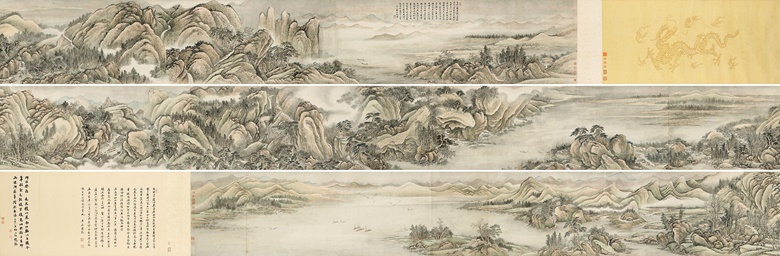
'I've never had a painting curlicue itself up when a new person walks into a room,' Hammer says. Even if you lot don't speak Chinese, and are not connected to the region, the painting will still have something to say to you. 'It wants to have a dialogue,' insists the specialist. 'The more y'all come up back to it, the more you will enjoy the chat.'
Source: https://www.christies.com/features/Chinese-Traditional-Painting-Collecting-Guide-7607-1.aspx
0 Response to "Why Do We Need to Understand Ancient Chinese Art"
Post a Comment